


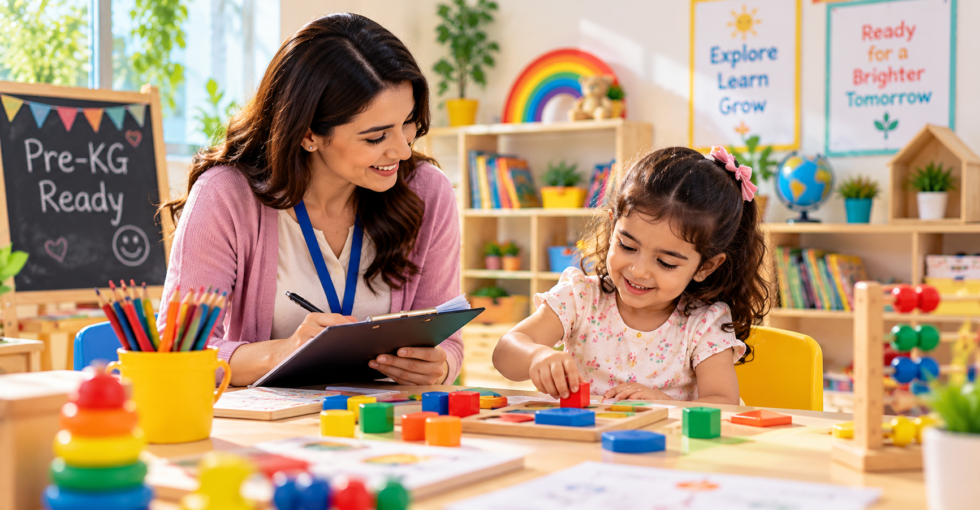

Moving from nursery into Pre-KG is a big step, and it’s natural to wonder whether your child is ready for Pre-KG or whether another term of nursery would serve them better. There’s no single test that gives a clear yes or no, but there are consistent signs that tend to show up when a child is genuinely prepared for a more structured classroom environment. This guide walks through what readiness actually looks like, what to watch for at home, and how to prepare your child if you decide the time is right.
What Is Pre-KG, and Why Does Readiness Matter?
Pre-KG sits between nursery and formal kindergarten, introducing more structured routines, longer group activities and a step up in independence expectations. Children aren’t expected to arrive fully polished, but a reasonable level of readiness makes the transition smoother for the child, the teacher and the rest of the class. A child who moves up before they’re ready can end up overwhelmed rather than challenged, while a child held back unnecessarily can get bored with material they’ve already mastered — which is why readiness is worth thinking through carefully rather than going by age alone.
How Pre-KG Differs From Nursery
Nursery is typically built around play-based exploration with a lot of one-on-one support. Pre-KG introduces more structured group time, longer seated activities, basic early literacy and numeracy exposure, and a greater expectation of following multi-step instructions without constant individual guidance. The National Association for the Education of Young Children describes readiness as a combination of social, emotional and cognitive development rather than any single skill, which is a useful frame for thinking about this transition. The shift isn’t dramatic, but it’s real, and it’s the reason readiness matters more at this stage than at earlier transitions.
Signs Your Child Is Ready for Pre-KG
These are the areas most nurseries and Pre-KG teachers look at when assessing whether a child is ready for Pre-KG. No child will tick every box perfectly, but a general pattern across most of these areas is a good indicator that your child is ready for Pre-KG rather than needing another term in nursery.
Independence and Self-Care Skills
Can your child manage basic self-care tasks with minimal help — using the bathroom independently, washing their hands, eating on their own, and putting on simple items of clothing like shoes or a jacket? Pre-KG classrooms generally have a higher child-to-teacher ratio than nursery, so a reasonable level of self-sufficiency in daily routines makes a real difference to how smoothly a child settles in.
Following Instructions and Group Routines
Pre-KG involves more group instructions than one-on-one guidance. A child who can follow a simple two-step instruction — “put your bag away, then come sit on the mat” — without needing it repeated individually is showing a skill that matters a lot in a classroom of twenty or more children.
Language and Communication Skills
Readiness isn’t about vocabulary size. It’s about whether your child can communicate basic needs, ask simple questions, and understand short instructions in whatever language is used in the classroom. A child who struggles to make themselves understood, or to understand simple classroom language, may benefit from more nursery-based language exposure before moving up.
Social Skills With Other Children
Can your child play alongside other children, take turns reasonably well, and handle small disagreements without becoming overwhelmed? Pre-KG classrooms involve far more peer interaction than one-to-one nursery settings, so comfort in group social situations is one of the stronger predictors of a smooth transition.
Attention Span and Focus
Pre-KG activities run longer than typical nursery sessions. A child doesn’t need to sit still for extended periods, but being able to stay engaged with a group activity, story or simple task for a reasonable stretch — without needing constant redirection — is a useful sign that the longer structure of Pre-KG won’t feel overwhelming.
It also helps to notice how your child recovers from a loss of focus. A child who can be gently redirected back to an activity after a brief distraction is usually coping better with structured time than one who becomes upset or disengages completely once their attention wanders. This kind of resilience tends to develop gradually, often without parents noticing it happening.
Signs Your Child Might Need a Little More Time
It’s just as useful to recognise when a child may benefit from another term in nursery. Frequent meltdowns during transitions, significant separation anxiety that hasn’t eased over several nursery terms, difficulty following even simple one-step instructions, or consistently struggling in group settings are all reasonable signs that more time to develop these skills — rather than a change of environment — is the better next step. None of this reflects badly on a child; readiness simply develops at different paces, and a nursery with a consistent Montessori and EYFS-based curriculum can keep building these skills at whatever pace suits your child.
How to Help Your Child Get Ready for Pre-KG
If you’re a few months out from a potential Pre-KG move, there’s a lot you can do at home to help your child get ready for Pre-KG without putting pressure on them.
Building Routine at Home
Consistent daily routines — set times for meals, play and sleep — help children internalise structure gradually, rather than encountering it for the first time on day one of Pre-KG. Involving your child in simple, repeated tasks, like packing their own bag or choosing their clothes, builds the kind of everyday independence that Pre-KG classrooms expect.
Practising Separation Confidently
If separation has historically been difficult, practising short, confident goodbyes — rather than lingering or showing your own anxiety about leaving — tends to help more than gradually increasing time apart. Children often pick up on a parent’s hesitation, so a calm, consistent goodbye routine is one of the simplest things you can do to ease this part of the transition.
Talking through what to expect on a typical Pre-KG day — in simple, reassuring terms rather than a long explanation — can also reduce first-day nerves considerably. Children generally feel more confident walking into a new routine when they have some idea of what’s coming, even if the details are approximate.
How Little Feet Nursery Helps Your Child Get Ready for Pre-KG
At Little Feet Nursery, our Montessori and EYFS-based curriculum is built to develop independence, communication and social skills gradually, well before a child is anywhere near the Pre-KG decision. Our teachers get to know each child individually, so when the time comes to talk about whether your child is ready for Pre-KG, the conversation is based on real day-to-day observation rather than a generic checklist.
This approach is consistent across all three of our branches — Al Khan, Al Khalidiya and Al Jazzat — within both our daycare and preschool programmes. If you’d like to talk through where your child is on this journey, our nursery admissions team is happy to have that conversation with you directly.
Conclusion
There’s no perfect checklist that tells you with certainty whether your child is ready for Pre-KG — but a consistent pattern across independence, communication, social skills and attention span gives you a much clearer picture than age alone. If you’re unsure, talking it through with your child’s current nursery teacher, who sees them every day in a group setting, is usually more useful than guessing on your own.
If you’d like an honest assessment of where your child stands, get in touch with our admissions team — we’re happy to talk through what we’re seeing and what might help.
Frequently Asked Questions
What age do most children move into Pre-KG?
This varies by nursery and curriculum, but readiness matters more than age alone. A child’s individual development in independence, communication and social skills is a better guide than a birthday.
What are the clearest signs my child is ready for Pre-KG?
Basic self-care independence, the ability to follow simple multi-step instructions, comfort playing alongside other children, and a reasonable attention span for group activities are the strongest indicators.
Is it a problem if my child isn’t ready yet?
No. Readiness develops at different paces for every child. Spending more time in nursery to build these skills is a normal and often better path than moving up before a child is comfortable.
How can I help my child prepare for Pre-KG at home?
Build consistent daily routines, involve your child in simple independent tasks like packing their bag, and practise calm, confident goodbyes if separation has been difficult.
Does separation anxiety mean my child isn’t ready?
Not necessarily. Some separation anxiety is normal and often improves with consistent routine and practice. Persistent, severe anxiety that hasn’t eased over time is worth discussing with your nursery.
Should I rely on my nursery’s opinion about Pre-KG readiness?
Yes, this is usually one of the most useful sources of insight. Nursery teachers observe your child daily in a group setting and can offer a more grounded view than a general checklist.
What happens if my child struggles after moving to Pre-KG?
Most nurseries and schools can offer extra support or, in some cases, discuss whether more time in an earlier stage would help. Raise any concerns with your child’s teacher as soon as they come up.
Does Little Feet Nursery help assess Pre-KG readiness?
Yes. Our teachers observe each child’s development over time and can talk you through specific signs of readiness, or areas that could use more support, whenever you’re ready to discuss it.