


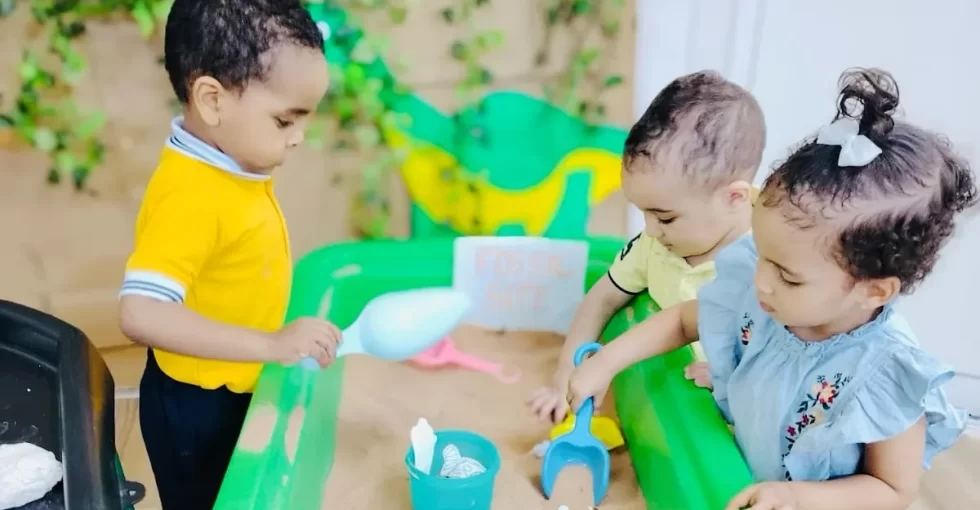

As children are growing up, every parent’s goal remains the same, in that they want their children to grow and develop to their fullest potential. Children are learning and growing using diverse methods and tools. It is sad to note that, these days, an important and even powerful tool for early childhood learning and development is often ignored that is, sensory play.
Sensory play is the type of play that involves one or more of the following sensations: touch, sight, sound, smell and even taste. As an example, children playing with playdough, children who splash around in water, or children who enjoy gardening (touching soil) they are engaging in learning and important development, although it may appear as fun.
Little Feet Nursery has been observing and claiming the development of children who grow up with and surrounded by sensory play and activities. For those who are interested in preschool in Sharjah or are just generally curious about nurseries near me for the foundational learning of your children, the preeminent point that you ought to understand is the value of sensory activities for the wonder of children’s education.
The following is a thoughtful study on the core note that sensory play and activities should be primary in a child’s learning journey. Along with that, this study discusses how these activities can be daily habits of the children.
The Science of Sensory Play in Child Development

The importance of sensory activities for children cannot be overemphasized: they aid children in laying down foundational neural pathways. During the first few years of life, a child’s brain develops and makes more than a million neural pathways per second. Sensory experiences are known to aid in reinforcing and cementing/working on these pathways, which in turn makes more neural pathways available for learning down the line.
Cognitive Benefits of Sensory Play
The ability to solve and analyze problems and think critically is greatly enhanced through sensory play. With the ability to easily manipulate and control sand and water, a child learns to grasp concepts of cause and effect, volume, and spatial relationships. Eventually, these concepts are pretty much the foundational concepts in mathematics and science.
How Sensory Play Boosts Language and Communication Skills
Rich sensory experiences provide children with vocabulary to describe their world. Words like the rough, smooth, squeaky, and cold become more familiar to a child through sensory engagements. Such vocabulary is communicative and foundational for literacy.
Emotional and Social Benefits of Sensory Play
Many sensory activities encourage children to share with their friends, which in turn fosters the ability to take turns and cooperate with others. Such activities strengthen their ability to persevere and control their emotions with the added bonus of reinforcing their social competencies. Sensory play particularly is known to be soothing and helps a child to regain control of their emotions.
How Sensory Play Supports Physical Development
Both types of motor skills are enhanced by the act of sensory play. Pinching, squeezing, and manipulating materials strengthen the small muscles needed for the act of writing, while the larger motions used in sensory activities develop coordination and balance.
Age Appropriate Sensory Activities That Aid in Learning
- Infants (0-12 months)
The first stage of learning can revolve around basic concepts of the world. This can be achieved through the positive use of tactile toys, musical instruments, and safe colorful objects.
- Toddlers (1-3 years)
The addition of sensory bins with rice, beans, and pasta can, arguably, provide more food. The same applies to engaging and lovingly made finger painting, manipulations of Play Dough, and Nature Walks.
- Preschoolers (3-5 years)
At this age, children may be more than willing to engage in as many extra sensory activities with other children, as in simple science activities, tending to a small garden, and determining the correct sequence in the comments of the step by step instructions to the recipe. The same applies to activities involving measuring and problem solving.
Creating Fun Sensory Play Experiences at Home
- Kitchen Based Sensory Play
Learning opportunities can be found in the kitchen with the use of measuring cups and other kitchen equipment. Math concepts such as measuring can be introduced, while the act of kneading dough helps develop hand strength. Exploring the textures of food helps with vocabulary expansion and encourages a balanced diet.
- Outdoor Sensory Exploration
Outdoor Nature unfolds a sensory paradise. Gathering leaves, listening to birds, and engaging with tactile surfaces like bark, grass, and stones gives rise to profound multisensory understandings. Gardening and tactile and scientific thinking at the same time.
- Indoor Sensory Exploration Stations
Dedicated sensory bins packed with rice, dried beans, water beads, or kinetic sand allow tactile exploration to take place in a safe and controlled manner. Rotating materials contributes to a positive and engaging learning atmosphere.
Safety Precautions for Sensory Play
- Age Appropriate Materials – Eliminate any possibilities of choking. Always Maintain supervision at all times.
- Personal Hygiene and Activity Orderliness – Clean hands before and after each activity.
- Allergy Precautions – Be aware of all sensory bin components and ensure there are no common allergens present.
How Quality Nurseries in Sharjah Integrate Sensory Learning
Acclaimed early childhood programs appreciate sensory play’s invaluable pedagogical worth. While searching or comparing nurseries in Sharjah, look first and foremost for thoughtful incorporation of sensory play.
At Little Feet, the best nursery in Sharjah, teachers understand how important sensory play is for children’s growth. They create safe and fun spaces where kids can explore, play, learn, and grow with confidence.
Long-Term Benefits of Sensory Play for Children
The impact of sensory play on a person does not stop at their childhood. Children with rich and varied sensory experiences demonstrate greater attention, enhanced imagination and heightened resilience, which leads to greater success in the academic and social spheres later on.
Sensory Play as a Pathway to Lifelong Learning
From tackling problems to engaging in critical thinking, sensory play encompasses a wide range of activities. It is through sensory experiences that children obtain the neural circuitry necessary for greater development (and) thinking, and learning.
Residents in search of a nursery near me in Sharjah, along with respected centers in the surroundings, should note that sensory play is a critical component of every child’s early learning experience. With every sensation of touch, taste, sound and other combined activities, children become perplexed with the surroundings, which later asks for building creative as well as inquisitive workforce for different levels of schooling and for the place of employment.