


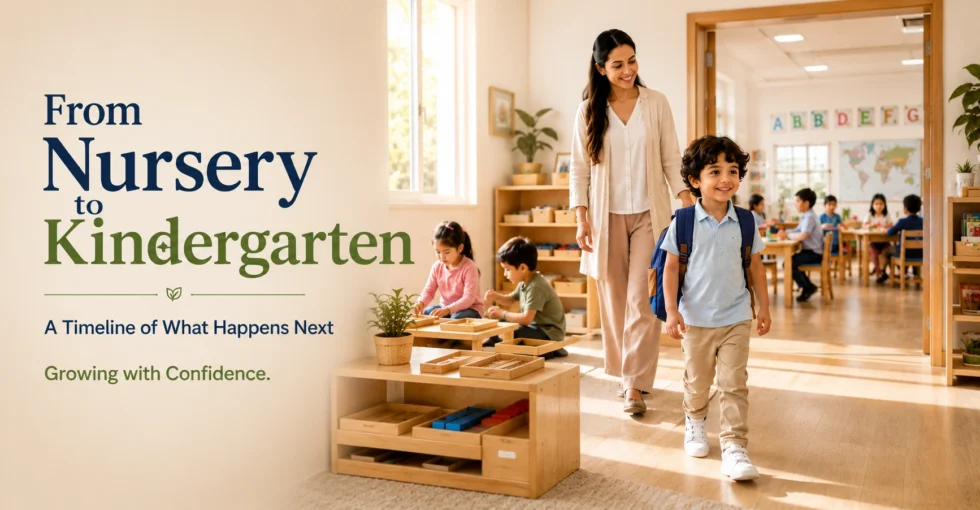

If you’re searching for a Kindergarten Transition Guide that actually tells you what to expect, month by month, you’re in the right place. Parents in Sharjah often assume the shift from nursery to kindergarten happens overnight. It doesn’t. It’s a gradual process – one that starts long before your child ever sets foot in a “Big School” classroom, and one that a good nursery in Sharjah should be actively preparing your child for, quietly, every single day.
At Little Feet Nursery, we’ve walked hundreds of families through this exact transition. What follows is the timeline we share with our own parents, built on what actually works – not on guesswork.
Why a Kindergarten Transition Guide Matters More Than You Think
Kindergarten readiness, often called school readiness, isn’t just about knowing the alphabet or counting to twenty. It’s a blend of cognitive skills, social-emotional development, and independence – three things that develop at different speeds in every child. A strong preschool in Sharjah builds all three simultaneously, through play-based learning rather than rote drilling.
Parents who understand this timeline tend to feel far less anxious during the final months before kindergarten. They know what’s normal, what to watch for, and when to actually worry (spoiler: less often than you’d think).
The 18-Month Timeline: From Nursery to Kindergarten
Ages 3 to 3.5: Building the Foundations
This stage is about exposure, not mastery. At a quality child care nursery, children are introduced to structured routines – circle time, snack time, tidy-up time – that build the internal clock kindergarten will later rely on heavily. Fine motor skills also take center stage here: holding a crayon, using safety scissors, threading beads.
Don’t expect academic output yet. Expect curiosity, short bursts of focus, and a growing comfort with being away from a parent for a few hours.
Ages 3.5 to 4: Play-Based Learning Takes Over
This is where a Montessori nursery Sharjah approach, guided by our Montessori and EYFS-blended curriculum, really earns its keep. Montessori materials – number rods, sandpaper letters, practical life trays – let children absorb early literacy and numeracy concepts through hands-on repetition rather than worksheets. Cognitive skills grow fastest when a child chooses an activity themselves and repeats it until it clicks.
For age-specific ideas you can use at home alongside nursery, our Montessori toy guide by age is a useful companion to this stage.
Social-emotional development accelerates too. Children start negotiating turns, resolving small conflicts with words instead of tears, and forming their first real friendships.
Age 4: Independence Becomes the Priority
Twelve months out from kindergarten, the focus shifts toward self-sufficiency. Can your child put on their own shoes? Zip a jacket? Ask a teacher for help instead of waiting to be noticed? These aren’t small things – kindergarten teachers manage 20-plus children at once, and independence is what lets a child thrive in that environment instead of feeling lost in it.
The Final Three Months: Kindergarten Preparation
This is the sprint before the transition. Nurseries typically introduce longer seated activities, simple worksheets, and mock “big school” routines – lining up, raising hands, following multi-step instructions. Some nurseries, including ours, run practice interviews and readiness assessments so nothing about the actual admissions process feels unfamiliar.
Signs of School Readiness to Watch For
Every child develops at their own pace, but by the final term of nursery, most children who are ready for kindergarten show a cluster of these behaviors:
- Sits and listens to a short story without needing constant redirection
- Uses full sentences to express needs, ideas, or frustration
- Follows two-step instructions (“get your bag, then line up”)
- Shows interest in letters, numbers, or books independently
- Separates from a parent without prolonged distress
- Attempts tasks independently before asking for help
- Plays cooperatively with peers, taking turns most of the time
If your child is missing several of these at once, that’s not a red flag – it’s simply useful information to bring to your nursery’s teaching team, who can build targeted support into the remaining months.
How a Montessori Approach Builds Real Independence
A lot of “school readiness” advice online focuses on academics alone. That’s a mistake. Independence is the actual predictor of how smoothly a child settles into kindergarten. Montessori-based programs are built around this idea from day one – children choose their own work, manage their own materials, and correct their own mistakes with minimal adult intervention.
This matters because kindergarten classrooms don’t offer the one-on-one attention a nursery does. A child who’s spent two years practicing independent decision-making adapts faster than one who’s only ever followed direct instruction.
Practical Tips for Parents During the Transition
A few habits make a measurable difference in the final months before kindergarten:
Start adjusting sleep and wake times to match the future school schedule at least a month in advance. Practice the morning routine – getting dressed, eating breakfast, leaving the house – on a fixed timeline, not a relaxed one. Talk about kindergarten positively and specifically, describing what a school day will look like rather than vague reassurances. Visit the new school if an orientation day is offered, even briefly. And keep communicating with your child’s current nursery teachers, who often notice readiness gaps before parents do.
Why the Right Preschool in Sharjah Matters Long-Term
Not every early learning provider treats this transition with the same seriousness. Some nurseries focus purely on childcare; others build a genuine early childhood development pathway that culminates in a confident, kindergarten-ready child. The difference shows up fast – usually within the first few weeks of “Big School,” when children either settle in comfortably or struggle to adjust.
At Little Feet Nursery, our Montessori and EYFS-blended curriculum is designed specifically with this timeline in mind. Every activity, from our Al Khan branch to our Al Khalidiya branch, builds toward the same goal: a child who walks into kindergarten ready, not just old enough.
Final Thoughts
The journey from nursery to kindergarten isn’t a single leap – it’s eighteen months of small, deliberate steps. Understanding this Kindergarten Transition Guide gives you a real framework to track your child’s progress instead of comparing them to other kids or vague milestones online.
If you’re currently searching for a nursery in Sharjah that treats kindergarten preparation as a genuine priority – not an afterthought – we’d love to show you around. Book a tour of Little Feet Nursery and see how our Montessori-based approach prepares children for the transition long before the final term begins.